

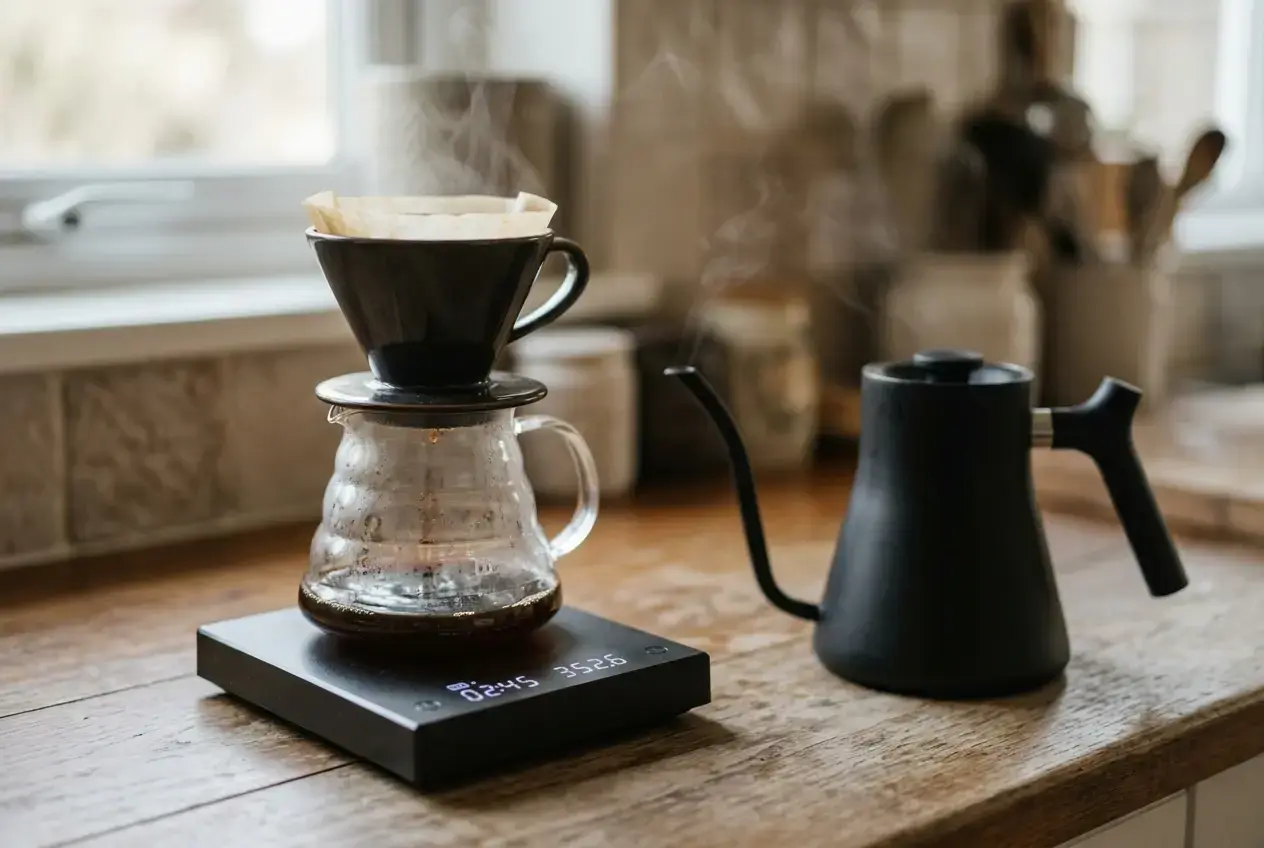
Most roundups of coffee scales read like spec sheets lifted straight from a manufacturer’s website: max capacity, resolution, battery type, done. None of that tells you what actually happens when you’re forty seconds into a pour over and the numbers on screen are lagging a full second behind the water hitting the bed. This article judges scales on three things that change what ends up in your cup: how fast the display catches up to a moving pour, whether the scale survives a splash when your gooseneck pour comes in at an angle instead of straight down, and how tight the accuracy actually is at the gram and tenth-gram level pour over ratios depend on.
If you’re still assembling the rest of your setup, the pour over coffee kit guide covers where a scale fits alongside your kettle, dripper, and grinder.
Why Scale Speed Matters More Than Most Brewers Realize
A scale’s weight reading isn’t instant. There’s a gap between water landing on the coffee bed and the number on the display catching up, and that gap is called refresh rate or sampling rate depending on the brand. On a cheap kitchen scale repurposed for coffee, that lag can run close to a full second. During a slow bloom, a one-second lag barely registers. During a fast pulse pour or a continuous pour where you’re adjusting flow rate in real time, a laggy scale is telling you where the water was, not where it is.
This matters because pour over technique is a feedback loop. You watch the number, you adjust the kettle angle or flow, you watch again. If the number you’re reacting to is already stale, you overshoot your target weight, pour past your bloom ratio, or end your draw down late because the scale hasn’t caught up to tell you it’s time to stop. A scale with a fast sampling rate closes that loop. You see the water hit the bed and the display tracks it in near real time, which means your adjustments are based on what’s actually happening rather than what happened a beat ago.

If you’re using a pulse pour technique, this is where scale speed stops being a nice-to-have. Pulse pouring means starting and stopping flow repeatedly, often in short bursts timed to hit specific weight checkpoints. A scale that’s slow to register each pulse makes it hard to know when you’ve actually hit your target, and you end up either stopping early out of caution or overshooting because the number hasn’t moved yet when you expect it to.
Water Resistance: The Spec Nobody Checks Until They Ruin a Scale
Gooseneck kettles are precise, but precise doesn’t mean dry. Pour at an angle, pour from slightly too high, or pour into a dripper with a narrow opening, and water finds its way onto the scale’s surface. It happens to nearly everyone eventually, usually during the moments when you’re focused on flow rate and bloom timing rather than watching where every drop lands.
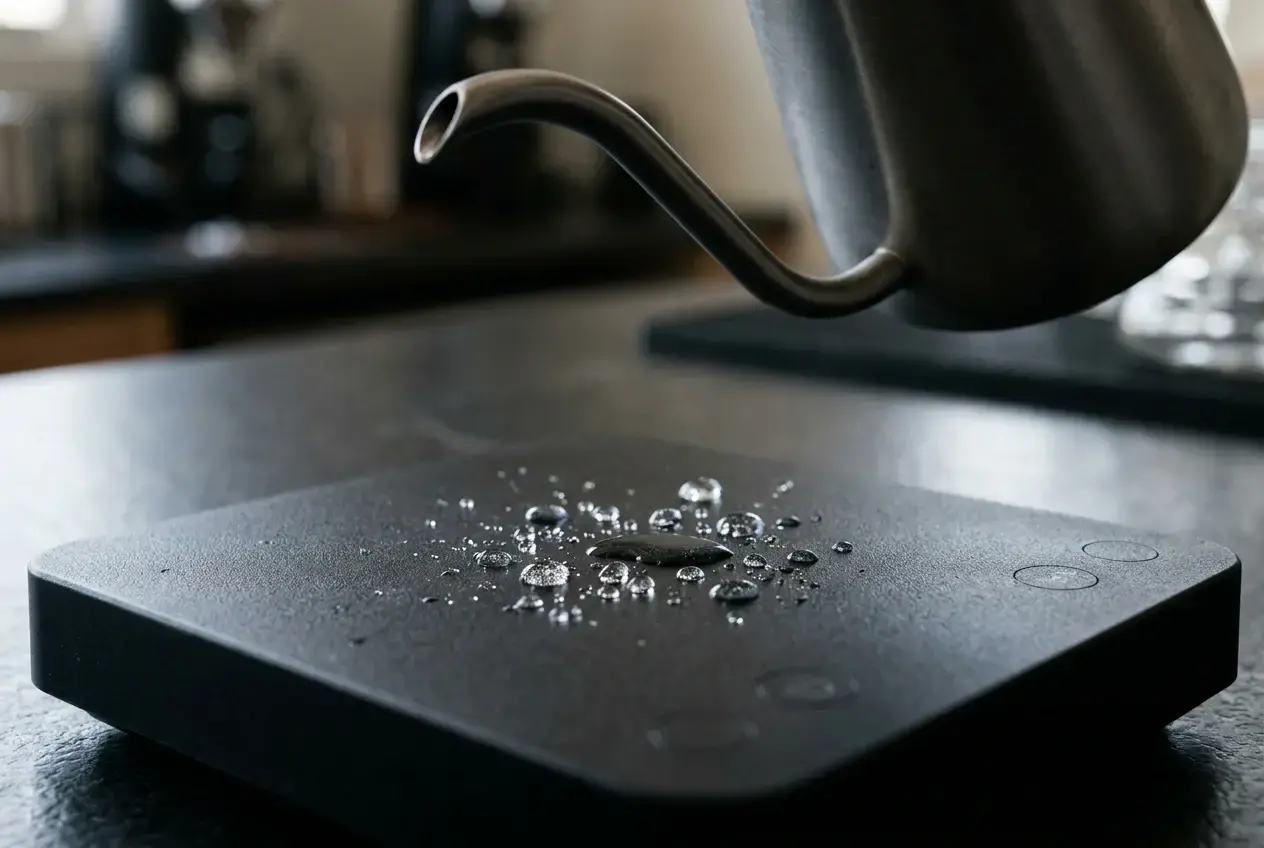
Most scales aren’t built to handle this. The weighing mechanism sits under a thin plate, and water that gets into the seams or around the buttons can corrode the load cell or short out the electronics. A scale that worked perfectly for months can stop reading accurately, or stop turning on at all, after one bad splash.
Splash resistance isn’t about the scale being waterproof enough to submerge. It’s about whether the housing seals around the edges and the control buttons, and whether the manufacturer has actually tested it against incidental spills rather than just listing a vague “water resistant” claim with no rating behind it. If you’re shopping, look for a scale that states an actual ingress protection rating rather than one that just says it resists moisture. A rated seal means someone tested it under controlled conditions. An unrated claim means it probably survives a damp cloth and not much else.
If your gooseneck kettle itself is part of the problem, an uneven pour spout or a handle angle that makes it hard to control flow makes splashing more likely in the first place. The gooseneck kettle guide walks through what makes a kettle easier to control at low, steady flow rates.
Accuracy at the Gram Versus the Tenth Gram: What You Actually Need
Pour over ratios are usually expressed as something like 1:16 or 1:15, coffee to water by weight. At the batch level, a scale accurate to the nearest gram is close enough. If your recipe calls for 300 grams of water, being off by half a gram here or there isn’t going to change the cup in a way you can taste.
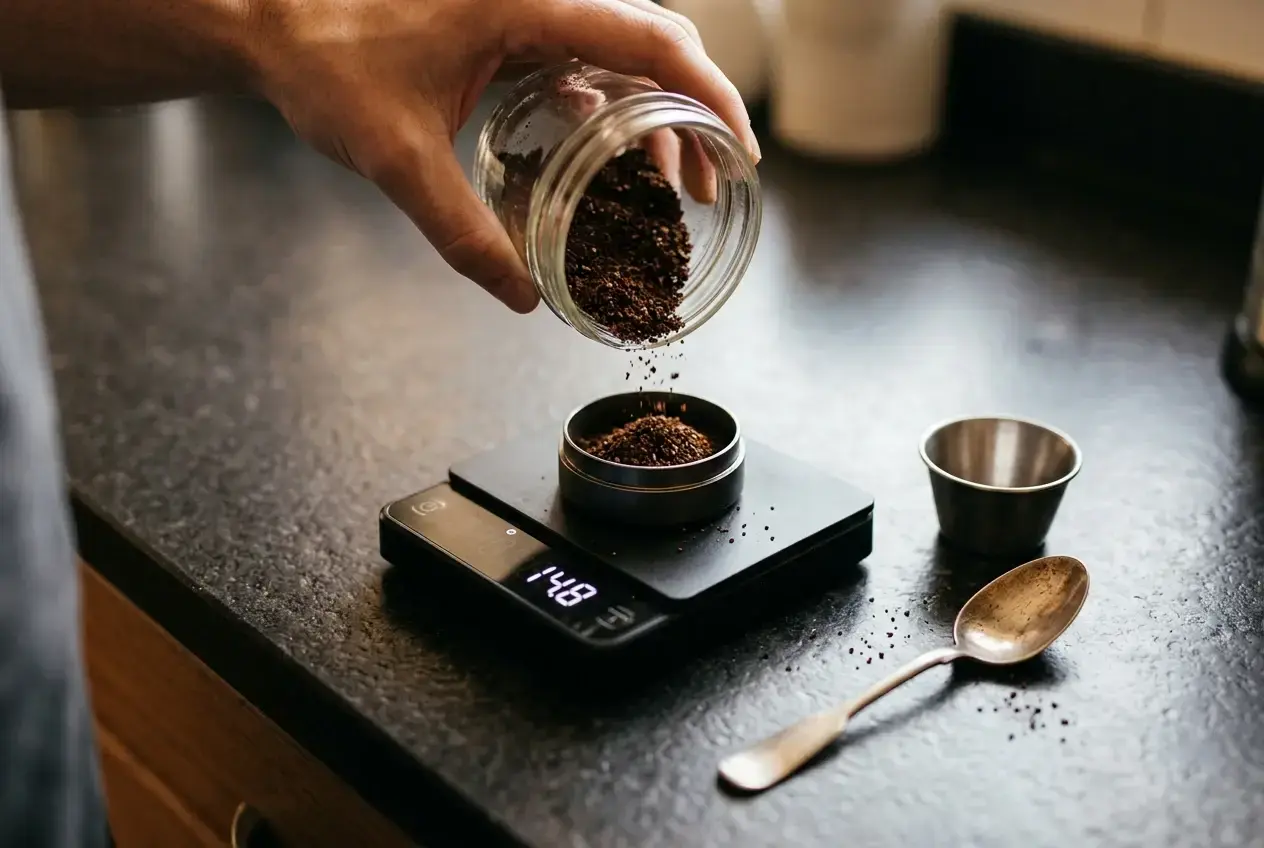
Where tenth-gram accuracy earns its keep is at the dose end, not the pour end. Weighing out 20 grams of coffee on a scale that only reads whole grams means your actual dose could be anywhere from 19.5 to 20.5 grams, a swing of roughly 2.5 percent. That’s enough to nudge your ratio outside the range where a recipe behaves the way it’s supposed to, especially on smaller brews where every gram is a bigger share of the total.
So the honest answer is: you need gram-level accuracy for your water, and you’ll benefit from tenth-gram accuracy for your coffee dose, particularly if you’re brewing single cups rather than large batches. If you’re brewing for one person most mornings, a scale that reads to the tenth of a gram removes a real source of ratio drift. If you’re mostly brewing in a Chemex for multiple people, the water volume dominates the math and gram-level accuracy is plenty.
For a deeper look at how these numbers translate into what you taste, the pour over coffee ratio guide breaks down how small shifts in ratio show up as strength and extraction differences.
The Scales Worth Buying, Ranked by Use Case Fellow Tally Pro Coffee Scale with Timer, Espresso Scale, Brew Assist Mode
(Best Overall)
The clearest pick for most pour over drinkers. Fast refresh rate, splash tolerance that holds up to an off-angle gooseneck pour, and tenth-gram accuracy that doesn’t drift over a session.
Timemore Black Mirror Basic
(Best Budget)
Slower refresh rate than the scales above it, but accurate enough for standard ratios and priced low enough to be a sane first scale.
Acaia Lunar
(Best for Speed)
The fastest display response in this lineup, built for brewers doing pulse pours or adjusting flow rate mid-pour in real time.
Hario V60 Drip Scale
(Best Built-In Timer)
Pairs a reliable tenth-gram readout with an onboard timer, useful if you don’t want a phone on the counter during your pour.
Built-In Timers and Flow Features: Useful or Gimmick
Built-in timers are genuinely useful. Pour over brewing runs on two clocks at once, elapsed time and weight, and having both on one display means you’re not glancing between a phone timer and a separate scale. For bloom timing especially, a scale that starts counting the moment you set your dripper down removes one more thing to track manually.
Flow rate displays, the kind that show grams-per-second in real time, are more of a mixed bag. They can help you see whether your pour is actually as steady as it feels, which is useful feedback early on. But they’re not something you need to chase a good cup, and a beginner staring at a flow rate number instead of watching the bed of coffee is arguably worse off than one just watching the water level rise.
App connectivity, where a scale pairs with a phone and logs your brews automatically, is the feature most likely to be a gimmick rather than a necessity. It’s convenient if you’re already tracking recipes carefully, but it adds another point of failure and isn’t going to change what’s in the cup.
Where a Great Scale Pays Off in Your Ratio and Technique
A fast, accurate, splash-resistant scale doesn’t improve your coffee on its own. What it does is remove the gap between the technique you’re trying to execute and the feedback you’re getting while you execute it. If you’re pulse pouring, a fast scale means you actually know when you’ve hit each checkpoint. If you’re dosing precisely, tenth-gram accuracy means your ratio is the one you intended rather than one with built-in error. If you brew near a sink or a kettle you’re still getting comfortable aiming, a splash-resistant housing means the scale is still working next week.
None of this is a requirement to make good pour over coffee. It’s possible to brew well without a scale at all, using volume and timing instead. But once you already know your ratio and you’re trying to repeat it reliably or push your technique further, a scale that keeps up with you stops being a convenience and starts being the thing standing between your intended recipe and what actually lands in the dripper.
Choosing the Right Scale for Your Brewing Style
Match the scale to what you’re actually doing at the kettle, not to the longest spec sheet. If you’re new to pour over and still building consistency, prioritize simplicity and gram accuracy over speed or extra features. If you’ve got your ratio dialed and you’re refining dose precision or pulse pour timing, prioritize sampling rate and tenth-gram resolution. If your pours tend to run a little wild, prioritize a sealed housing over everything else, because a scale that doesn’t survive your brewing style isn’t the right scale no matter what else it does well.
Check the affiliate disclosure for how this site handles product recommendations, then use the pour over coffee ratio guide to put your new scale straight to work.