
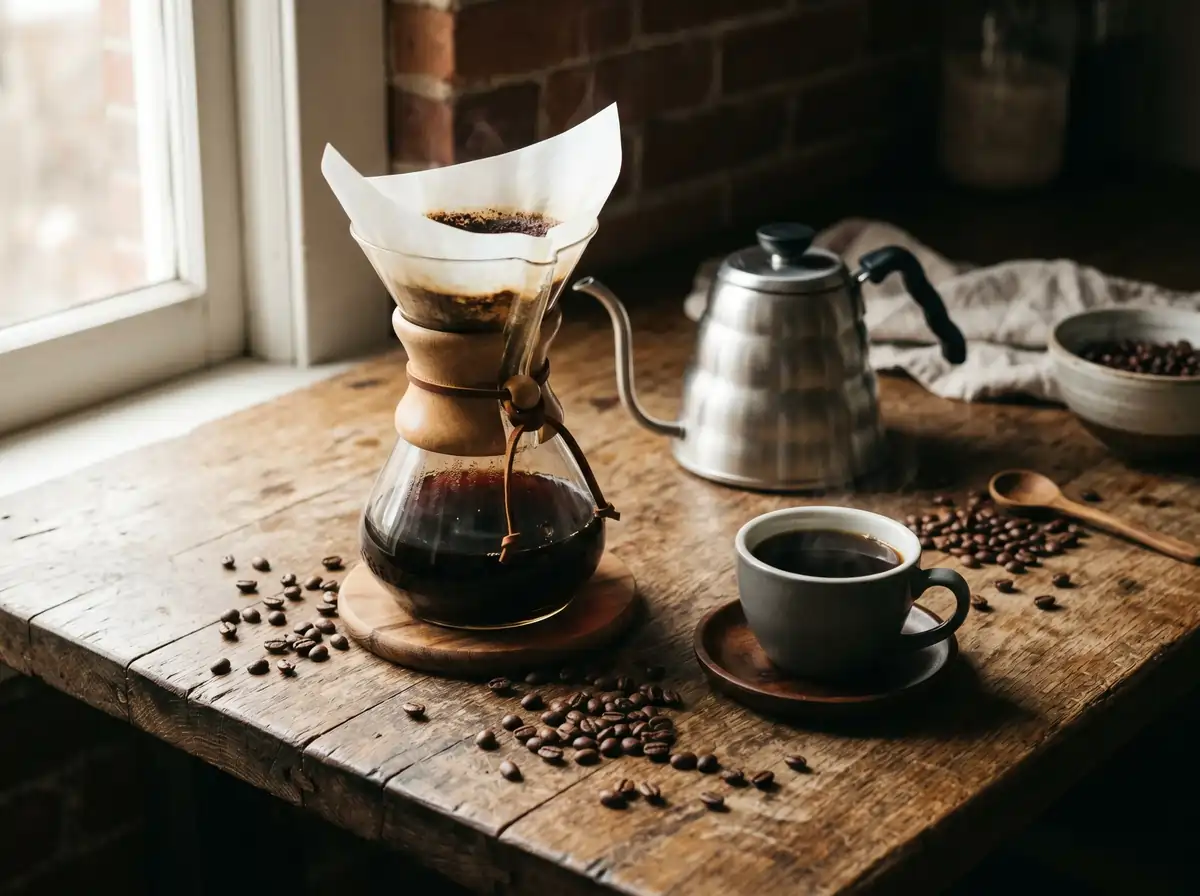
Looking for a way to make coffee that’s clean, smooth, and a little bit fancy? The Chemex has a reputation for ticking all those boxes, and honestly, it deserves the hype. Brewing with a Chemex isn’t hard, but there are a few tips and tricks that make the process way easier. The results are noticeably better.
I put together this guide for anyone curious about how to use a Chemex. Whether you’re just getting started or looking to improve your routine, you’ll find straightforward steps, common mistakes to watch out for, and solid tips for nailing that clean, balanced cup. Here’s everything you need to get going with Chemex coffee at home, plus a few pointers to help you make each cup the best it can be.
Disclaimer: This page contains affiliate links. If you make a purchase after visiting a link I may receive a small commission. This in no way affects my recommendations and carries no impact on price.
What Is A Chemex And Why Do People Love It?
The Chemex is a classic pour over brewer. It looks almost like it belongs in a fancy science lab. With its elegant glass hourglass shape and wooden collar, it’s as much a décor piece as it is a coffee maker. But it’s not just about eye-catching looks. The Chemex is popular among coffee fans and the SCA for the unique qualities it brings to every cup.
To learn about all the best pour over coffee methods, check out the best pour over coffee methods in 2026
What makes the Chemex different from other pour over brewers
At first glance, a Chemex might look similar to other pour over options like the Hario V60 or Kalita Wave. But a few things set it apart:
- The filter is way thicker. Chemex filters are almost like coffee filter paper on steroids. They’re heavily bonded, which slows down brewing and traps more fine particles than standard filters.
- The shape of the Chemex lets the coffee drain straight down through a single outlet without obstructions, so you get a super-clean extraction.
- It brews larger batches than many other pour over drippers. If you like to make coffee for two (or more), the Chemex is pretty handy.
Why Chemex coffee tastes so clean and smooth
The real magic comes from those thick filters. They grab a lot of the oils, micro-grounds, and bitterness that sometimes sneak through when using thinner filters. So Chemex coffee tends to be less gritty and much smoother than what you get with, say, a French press or some other pour over brewers. If you like coffee that’s crisp, bright, and lets subtle flavors shine, Chemex is the way to go.
Is the Chemex a good choice for beginners?
Yes, the Chemex is a great starting point! The learning curve is gentle, and you don’t need a bunch of extra gear. The steps, as you’ll see, are simple. Plus, the Chemex is very forgiving. Even if you don’t get everything perfect, you’ll usually end up with a tasty cup that feels way fancier than regular drip coffee. Its big filter also gives you a little buffer against over- or under-extraction, which helps beginners nail great cups early on.
What You Need To Brew Coffee In A Chemex
Here’s a quick checklist of what you need before making your first Chemex coffee. The right stuff makes a big difference, but you definitely don’t have to get too fancy.
The basic Chemex brewing equipment
- Chemex coffee maker (choose the size based on how much coffee you want. The 6-cup and 8-cup versions are the most common)
- Chemex paper filters (the square or circular ones designed for your specific size)
- A gooseneck kettle (super helpful for more control, but a regular kettle does the job too)
- Good quality burr grinder (fresh grinding is super important for taste)
- Digital scale (makes recipes repeatable, but you can eyeball it in a pinch)
- Timer (your phone works just fine)
Why Chemex filters matter so much
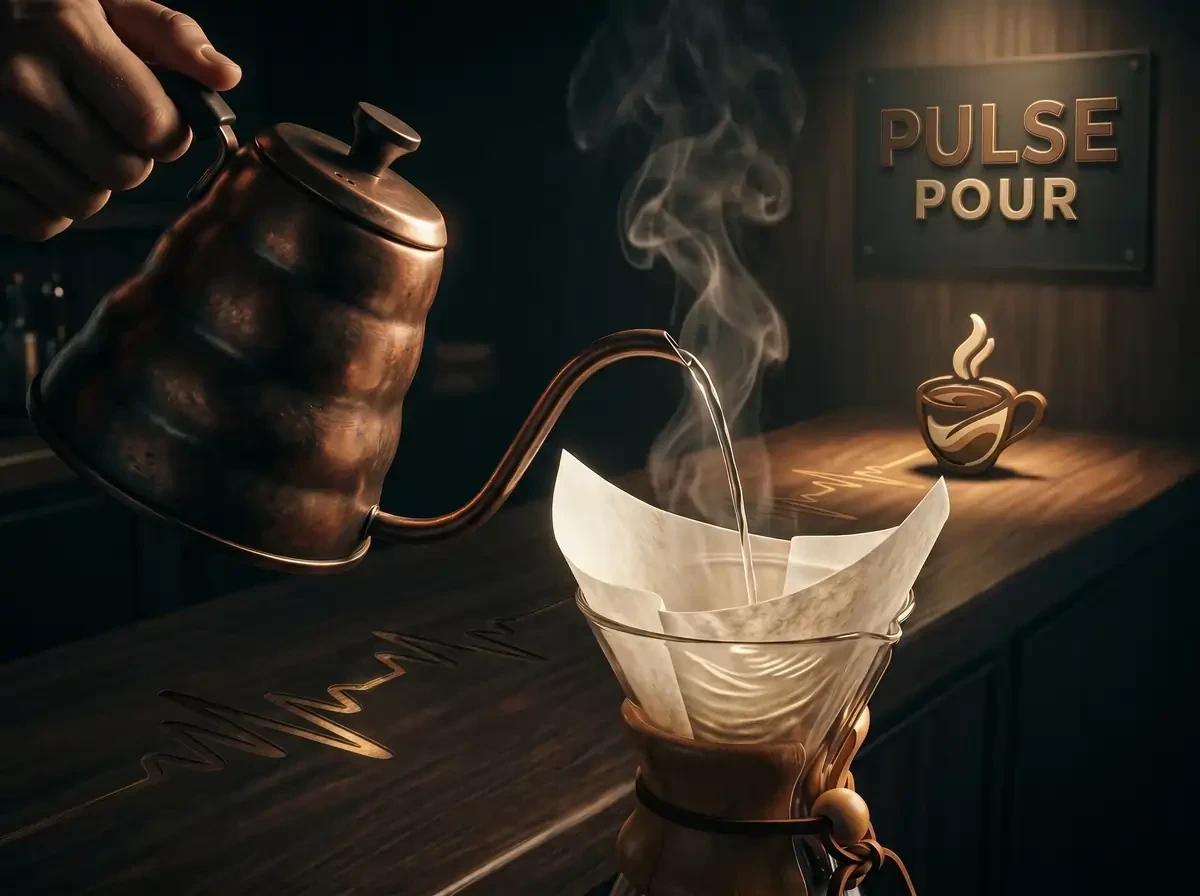
Chemex filters are a bit of a splurge compared to ordinary filters, but they’re worth it. Because they’re so thick and dense, they filter out more coffee grit and unwanted bitterness. Using the right filter is key to that signature Chemex profile—skipping the proper filters kind of defeats the purpose! Most folks use the official Chemex paper filters, but third party options exist. If you can, always grab the “authentic” ones for best results. Just check you have the right shape and size for your Chemex.
The best coffee beans for a clean and balanced cup
Since the Chemex highlights clarity and gentle flavors, medium or light roasts work really well. Choose coffees that mention notes like citrus, berry, florals, or cocoa—those often shine in a Chemex. If you’re unsure, go for beans that are freshly roasted and avoid anything labeled “espresso roast” for now. Freshness is key: the closer to the roasting date, the better your cup.
A Simple Chemex Recipe For Beginners
You don’t need to overthink your first Chemex brew. Here’s an easy Chemex recipe for beginners that works every time. You can tweak it once you get the hang of things and make it fit your personal taste.
Coffee to water ratio for Chemex brewing
The classic starting point is 1:15 or 1:16, meaning one gram of coffee for every 15 to 16 grams (or milliliters) of water.
- For a single mug (about 350ml), use 22 grams of coffee and 350 grams of water.
- For a full Chemex (about 700ml), use 44 grams of coffee and 700 grams of water.
A digital scale takes out the guesswork, but if you don’t have one, two level tablespoons of ground coffee per 6-ounce cup is a decent rough estimate.
The best grind size for Chemex coffee
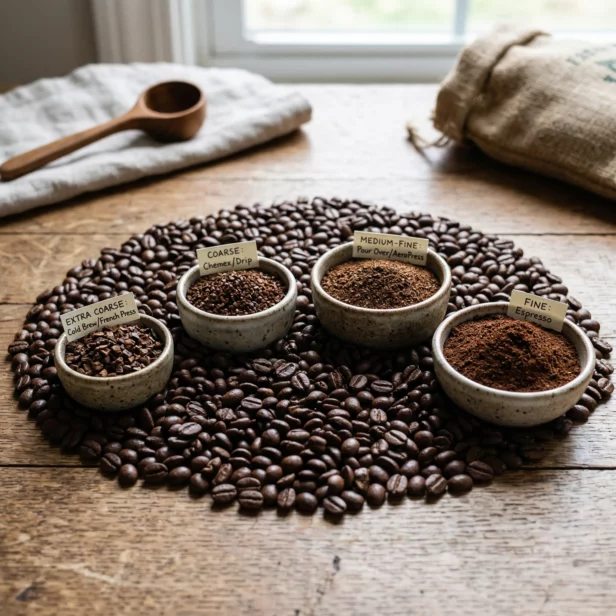
This is really important: the best grind size for Chemex is a medium-coarse grind—not as chunky as French press, but a bit coarser than standard drip machines. It should look like sea salt or rough sand. If you grind too fine, you’ll get over-extracted, bitter coffee and possibly a clogged filter. If it’s too coarse, your brew will taste weak and thin. Start with medium-coarse and adjust from there.
Water temperature and brew time to aim for
You want your water just off the boil, about 200°F (93–96°C). If you don’t have a kettle with temperature control, just boil your water, then let it sit for 30 seconds before pouring. Brew time from start to finish typically lands at 4–5 minutes for the classic Chemex pour over recipe.
A beginner friendly Chemex recipe you can repeat
- Fold and rinse your Chemex filter. Place it thick side (three layers) over the spout.
- Add 44g medium-coarse ground coffee to the filter (for a full brew), level it out.
- Start your timer and slowly add about 80g of hot water, just enough to saturate all the grounds for the “bloom.” Wait 30–45 seconds.
- Continue pouring in a thin, slow spiral until you reach 700g of total water.
- Let it drain completely (should finish at about 4–4.5 minutes). Remove the filter, swirl your Chemex, and serve!
This Chemex recipe for beginners is very repeatable, and a solid jumping off point for customizing to your taste. Once you have a feel for it, play with grind, dose, or pour style to see what you like best.
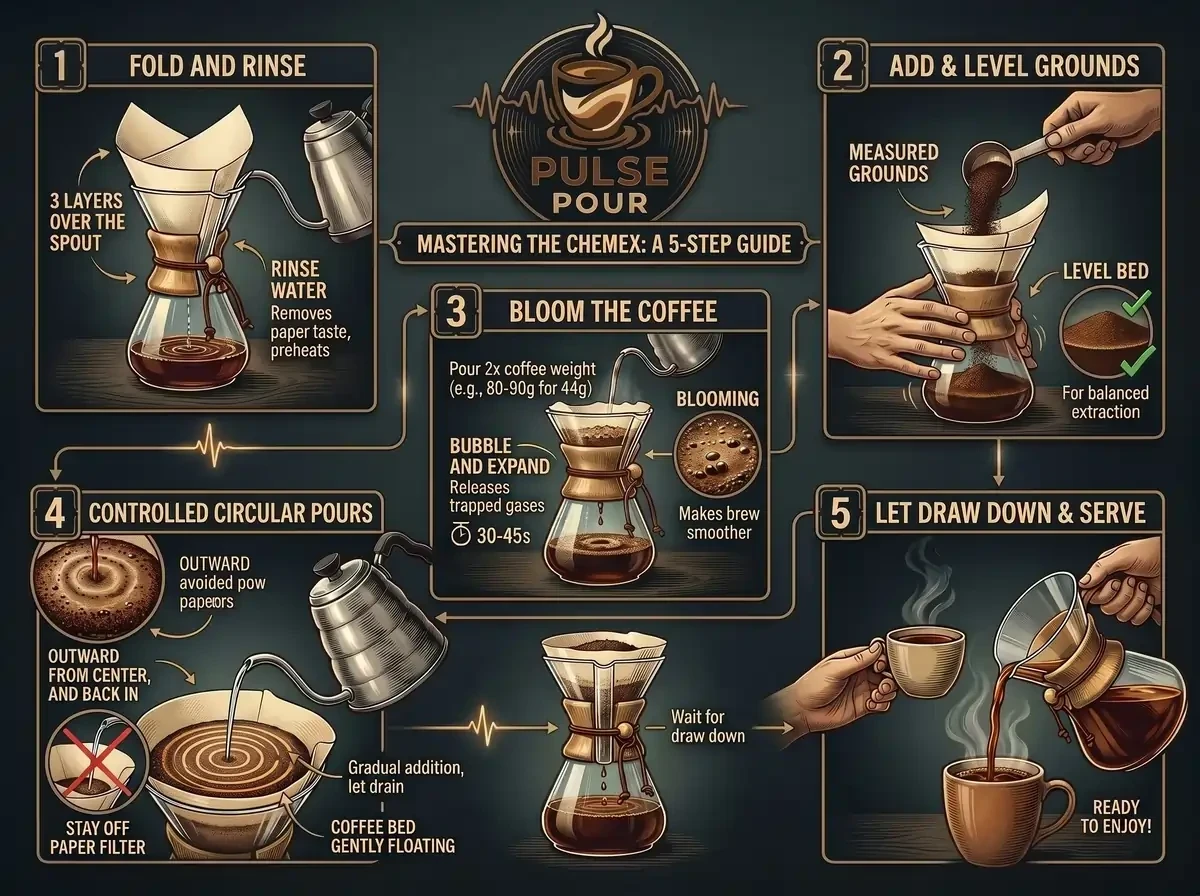
How To Use A Chemex Step By Step
Here’s how I make Chemex coffee at home, step by step. Follow these simple tips and you’ll enjoy smooth, balanced cups every time.
Step 1: Fold and rinse the Chemex filter
Open the Chemex filter into a cone shape. Put the side with three layers over the pouring spout. This helps prevent the filter from collapsing and clogging the spout during brewing. Pour hot water through the filter, soaking it and warming up the glass, then pour out the rinse water. This step removes any papery taste and preheats your brewer.
Step 2: Add your ground coffee and level the bed
Add your measured ground coffee to the Chemex filter. Gently shake or tap the Chemex to level off the grounds. Leveling helps water flow evenly through the coffee bed, delivering a more balanced extraction.
Step 3: Bloom the coffee for even extraction
Pour a small amount of hot water (twice the weight of the coffee, so for 44g coffee, use about 80–90g water) right in the center, making sure all the grounds are saturated. You’ll see the coffee bubble and expand; that’s called blooming. It releases trapped gases and makes the rest of the brew smoother. Wait 30–45 seconds before the next pour.
Step 4: Pour slowly in controlled circles
After the bloom, use a slow, steady pour in small circles, moving outward from the center and back in again. Try not to pour directly onto the paper filter, but instead stick to the bed of grounds. Add water gradually, letting it drain a bit before each new pour. The goal is to keep the coffee bed gently floating in water, not flooded or exposed.
Step 5: Let the coffee draw down and serve
When you’ve reached your target water weight, let the coffee drain through the bed. It should take about 4–5 minutes total from your first pour to the last bit passing through the filter. Remove the filter, give your Chemex a swirl, and enjoy your fresh cup!
Common Chemex Mistakes And How To Avoid Them
There are a few classic Chemex mistakes that just about everyone bumps into at first. Spotting these early saves a lot of frustration and helps each brew taste smoother and more balanced.
Grinding too fine or too coarse
If the water drains really slowly or your coffee is extra bitter, your grind is probably too fine. On the flip side, if water runs through quickly and your cup is weak and watery, you’ve likely ground too coarse. Aim for a texture just a bit finer than French press, a little coarser than drip. Fine tune it in small steps until you find what tastes best.
Pouring too fast or unevenly
Pouring too quickly can cause “channeling,” where water carves a path through grounds, missing others. That means some grounds over-extract and others under-extract, leading to a bitter or weak cup. Keep your pour slow and even, in spiral motions, and avoid dumping in all the water at once.
Using the wrong filter placement
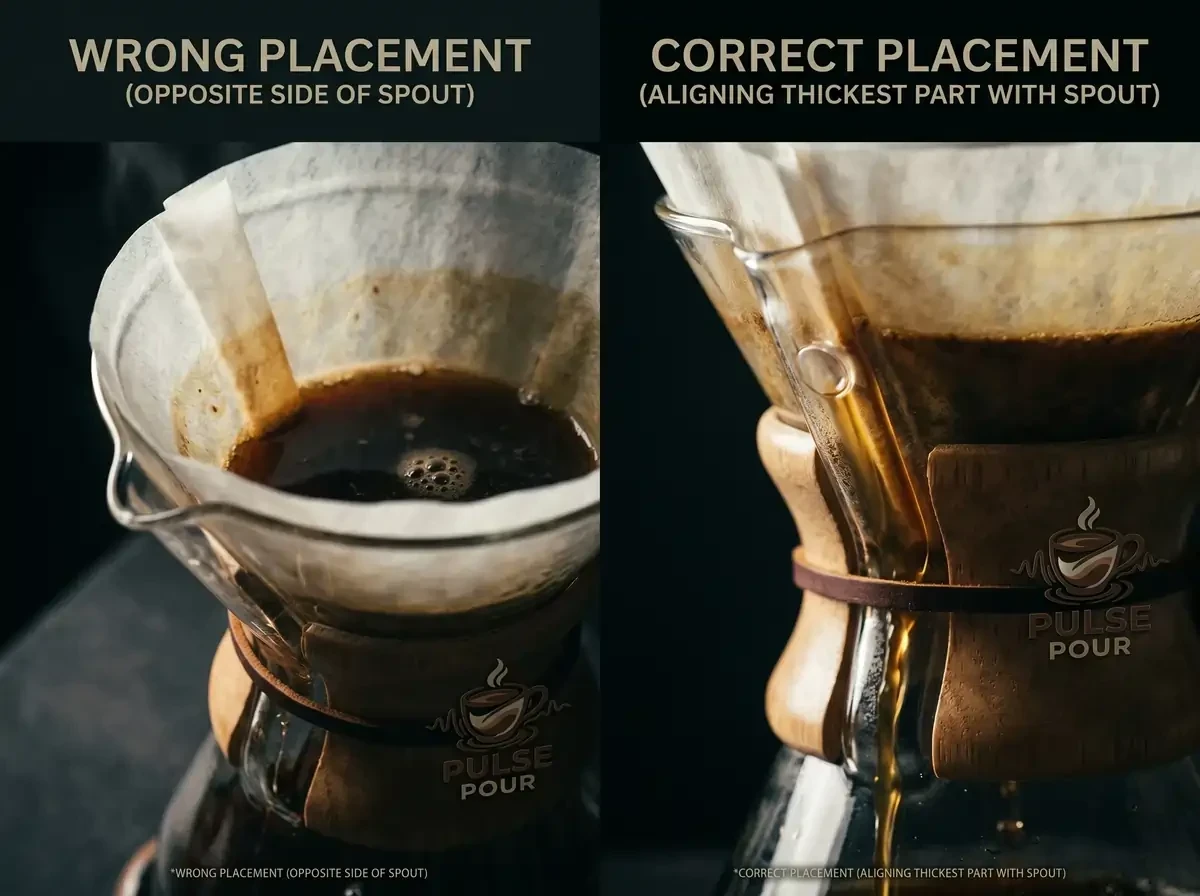
If you place the filter seam on the wrong side, away from the spout, the filter can block airflow and cause a vacuum. Always align the thickest part of the filter with the spout so air can escape and coffee drains smoothly.
Letting the brew stall
If the water sits there and doesn’t drain, your grind is way too fine, or your filter collapsed against the glass. Start over with a coarser grind and check the filter’s placement. This can also happen if you carelessly pour water outside the coffee bed onto the paper instead of the grounds.
Changing too many variables at once
When troubleshooting, change only one thing at a time—grind size, water temperature, pour speed, or coffee to water ratio. This way it’s easier to track what’s making things better or worse, rather than guessing in the dark.
How To Adjust Your Chemex Brew Based On Taste

Brewing at home means you get to tweak things until you find your perfect cup. Here’s how I handle common flavor issues to keep things tasting smooth and delicious.
What to change if your Chemex coffee tastes sour
Sour, overly bright cups usually mean under-extraction. Try using a slightly finer grind or lengthening your total brew time. You can also increase your water temperature if needed. Make small changes, tasting the difference each time.
For more information on fixing sour pour over coffee, check out why your pour over coffee tastes sour & how to fix it.
To check out the Top 5 Manual Coffee Grinders check out the link
What to change if your Chemex coffee tastes bitter
Bitter or overly dark-tasting coffee means you’ve probably over-extracted. Use a coarser grind and double-check your water isn’t too hot. Pouring a bit more slowly and shortening total brew time can help ease up the bitterness.
For more information on how to fix bitter pour over coffee, visit why your pour over coffee tastes bitter & how to fix it.
What to change if your Chemex coffee tastes weak
Weak or watery Chemex coffee often comes from a grind that’s too coarse, too little coffee, or pouring too fast. Try grinding a bit finer or using more coffee. Slow down your pour and be precise with your coffee to water ratio for a stronger result.
For more info on how to make your pour over stronger, check out Why your pour over coffee tastes weak and how to make it stronger.
How to get a smoother and sweeter cup
If you want a sweeter, more balanced cup, use fresh, high-quality beans and keep your pouring consistent. Sometimes just a tiny change in pour speed or water temperature brings out more sweetness and a silkier mouthfeel. Don’t be afraid to experiment a little.
Tips For Brewing Better Chemex Coffee At Home
Once you’ve nailed the basics, a few habits can step up your Chemex brewing. These tips make the biggest difference for me:
Use fresh beans and grind right before brewing
Freshness is a big deal for pour over. Buy whole beans in small amounts and grind just before you brew. The flavors really pop and your cup comes out brighter and sweeter, just like the Chemex was made for.
And if you don’t have a scale, you can still make great pour over coffee without one, here’s how
Keep your pouring steady and consistent
Training your hand to pour slowly in a controlled spiral is one of the best ways to improve your Chemex brew. After a few rounds, you’ll find your flow and be able to be consistent every time.
Use filtered water for a cleaner taste
Tap water with too many minerals or chlorine can spoil the clean clarity Chemex is known for. Try filtered or bottled water for brewing coffee at home—it really makes a difference.
Clean your Chemex thoroughly between brews
Dried coffee oils can cling to the glass and wood and make future cups taste stale. Rinse the Chemex well after every use and scrub with soap every so often. Try not to get the wooden collar soaked, as it can dry out or crack over time.
Chemex Brewing FAQ
I get a lot of questions about brewing Chemex coffee. Here are some of the most common ones people ask me, in and out of the kitchen.
What grind size is best for Chemex?
The best grind for Chemex is medium-coarse, a touch finer than French press but coarser than drip. Picture rough sea salt. If it’s too fine, you get a bitter, slow brew; too coarse, and the cup will lack flavor and body.
How much coffee should I use in a Chemex?
Start with a ratio of 1:15 to 1:16 (one gram of coffee to 15–16 grams of water). For a full 6- or 8-cup Chemex, use around 44 grams of coffee to 700 grams of water. Adjust as you find your sweet spot.
How long should a Chemex brew take?
Total brew time should be about 4–5 minutes from your first pour to the last drop leaving the filter. If it’s taking much longer, try a coarser grind; if it’s too fast, go a bit finer.
Why is Chemex coffee so smooth?
The thick filters and slow extraction leave most of the oils and fine coffee particles behind, which makes Chemex coffee taste so clean and smooth while letting subtle flavors shine through.
Want to get your perfect cup of pour over? Check out how to perfect your pour over coffee brewing.
Final Thoughts On Learning How To Use A Chemex
The Chemex keeps things simple, but gives you enough control to adjust and experiment with your process until you nail it. Don’t stress about being perfect on your first brew. Instead, stick to the steps, repeat your process, and switch up one thing at a time if you want to play with flavor.
Start simple and focus on consistency
Consistency gives you the most improvement. Keep your routine steady for a few brews before you start making changes. Very quickly, you’ll start spotting what matters most for your own taste, and soon you’ll have a Chemex pour-over recipe dialed in just for you.
Small changes can make your Chemex coffee much better
Experiment with grind size, pouring style, and coffee to water ratio in small steps. Taste as you go and jot down a note or two if it helps. Every tweak adds up, and the process is a fun part of being a home barista. When you hit that perfect, clean, smooth cup, it’s totally worth it.
To help you keep track of adjustments and pick out different flavor notes, I’ve put together a Tasting Journal and Flavor Wheel for you to use. All you have to do is subscribe to the newsletter below.
It covers everything from troubleshooting strategies to perfecting your pour over brew. Help with gear and pour over equipment is included.
If you have other Chemex questions or want to share your favorite Chemex recipe for beginners, just drop a comment. I’m always happy to talk coffee and compare notes with fellow fans!
Continue Learning
Perfecting Pour Over
Want to perfect your pour over coffee? It may seem simple, but there’s a lot that can go wrong on your path to perfection. Try this instead.
How to Clean A Pour Over Coffee Maker

If your pour over coffee has started tasting a little flat, bitter, or just not as clean as it used to, your gear could be part of the problem. Coffee oils, residue, and mineral buildup can build up faster than most people realize, and even great beans will struggle to shine if your setup is not clean.